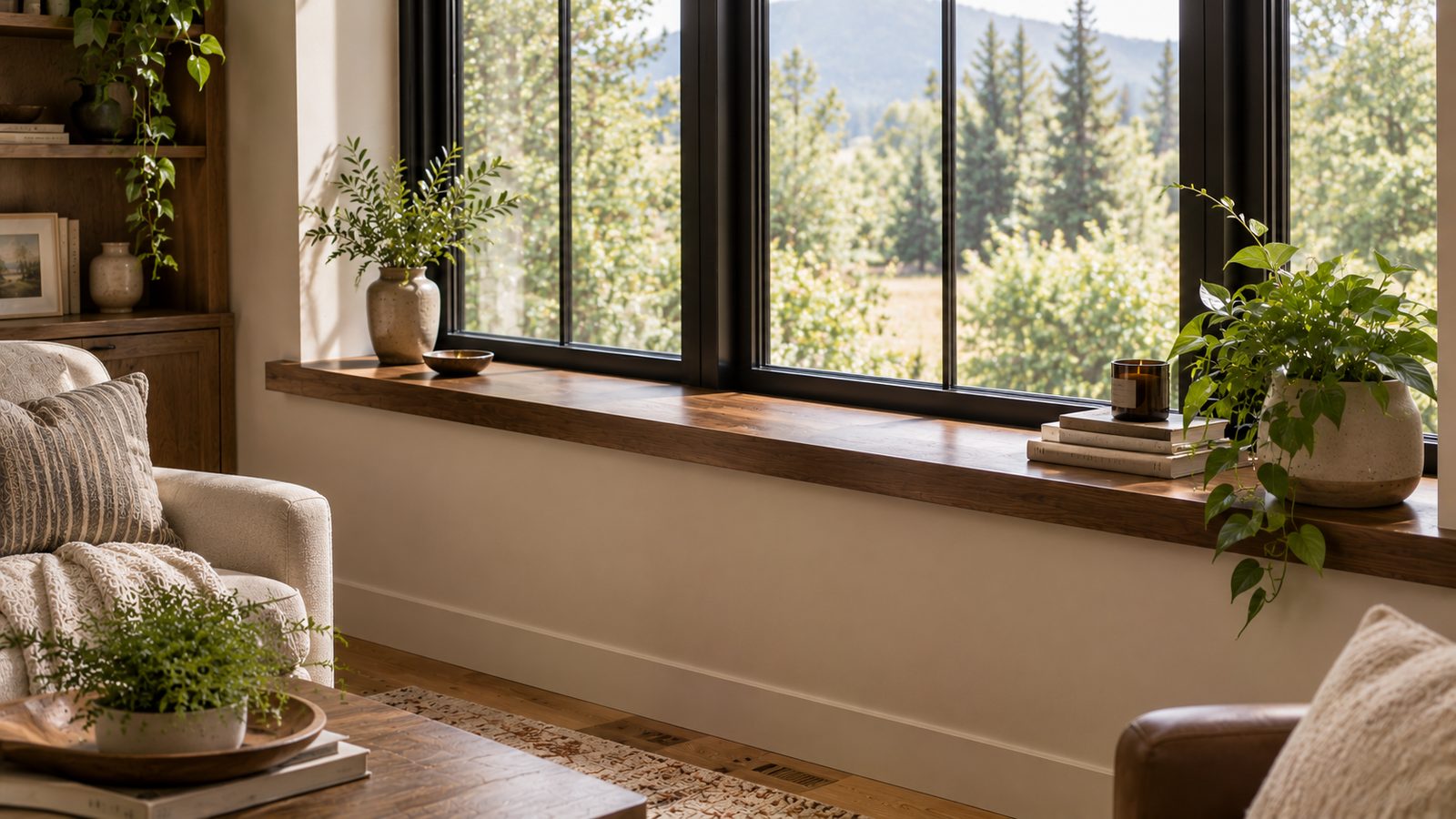
Handcrafted Hardwood Window SillsMade to your opening, finished, and shipped anywhere in the US
A solid hardwood window sill cut to your own measurements — white oak, walnut, cherry, maple or hickory, in eighteen photographed finishes, with a machined edge profile and returns if you want them. You configure it in the browser, see it rendered in 3D as you go, and approve a dimensioned drawing before anything is cut.
- Construction
- 3/4″ solid hardwood slab with a laminated built-up front edge
- Visual front thickness
- 1″, 1-1/2″, 2″ or 2-1/2″
- Species
- White oak, walnut, cherry, hard maple, brown maple, hickory, oak
- Edge profiles
- Eased, bevel, radius, cove, ogee, roman ogee — top arris, bottom, or both
- Shapes
- With or without returns; continuous runs across two or three windows
- Before we build
- A two-sheet dimensioned drawing and a downloadable 3D model
- Shipping
- Nationwide, United States
Sill, stool, apron — and why we say “sill”
Strictly speaking, the sill is the sloped exterior member that sheds water off the outside of the window. The flat interior board you set a plant on is the stool, and the trim beneath it is the apron.
Almost nobody uses those words that way. Carpenters argue about it on every forum where it comes up, and homeowners search for “window sill” by an enormous margin. So we call it a sill, because that is what people call it — but what we actually make is the interior stool, and if you are working from an architect’s drawing that is the word you will see.
| Part | Where it is | Also called |
|---|---|---|
| Stool | The flat interior board across the bottom of the opening. This is what we make. | Window sill, window board, window ledge, stool cap |
| Sill | The sloped exterior member, outside the window | Exterior sill, sub-sill |
| Apron | The trim directly below the stool, on the wall | Skirt |
| Jamb | The vertical sides of the opening | Reveal, return jamb |
Why solid hardwood, and where it is the wrong answer
A window sill lives in the worst spot in the room for a board: direct sun on one side, cold glass above it, and condensation running down onto it every winter morning.
| Material | How it behaves at a window | Best for |
|---|---|---|
| MDF | Swells when it takes on water and does not shrink back — the damage is permanent. The single most common sill complaint on home-improvement forums. | Dry openings, painted, tight budget |
| Finger-jointed pine | Paint-grade and soft; dents from a dropped object, and the joints can telegraph through paint over time. | Painted trim, budget work |
| Solid surface | Non-porous and effectively immune to the moisture problem. Cold to the touch, and it does not read as wood. | Bathrooms, kitchens, high-moisture rooms |
| Solid hardwood | Moves seasonally with humidity, which has to be designed around rather than ignored. Takes stain, can be sanded and repaired, and unlike the others it gains character rather than losing it. | Rooms where the sill is meant to be seen |
Where we would tell you to buy something else
If the sill is going in a bathroom that steams up daily, or a kitchen window over a sink, solid surface will outlast hardwood there and we make that too. If the sill will be painted white and never looked at again, a primed pine or MDF stool from a lumberyard will do the job for a fraction of what we charge, and we would rather say so than sell you a hardwood sill you did not need.
Wood moves. Here is how much.
Every hardwood expands and contracts across the grain as indoor humidity swings between summer and winter. The species you pick changes how much. These are the published total shrinkage figures from the USDA Forest Products Laboratory Wood Handbook, green to ovendry — useful for comparing species against each other rather than predicting a number for your room.
| Species | Tangential | Radial | What that means for a sill |
|---|---|---|---|
| Cherry | 7.1% | 3.7% | The steadiest of the group. A good choice for a wide opening. |
| Walnut | 7.8% | 5.5% | Moves little and evenly, so it is unlikely to cup or twist. |
| Red oak | 8.6% | 4.0% | Wide gap between the two figures — worth quarter-sawing on a broad sill. |
| Hard maple | 9.9% | 4.8% | Moves more; pale and even-grained, so any movement shows less. |
| White oak | 10.5% | 5.6% | Moves the most of these, and is also the most rot-resistant. |
White oak moves roughly one and a half times as much as cherry across the grain (10.5% against 7.1%). All five are used for window sills every day — the difference matters most on a wide, multi-window run.
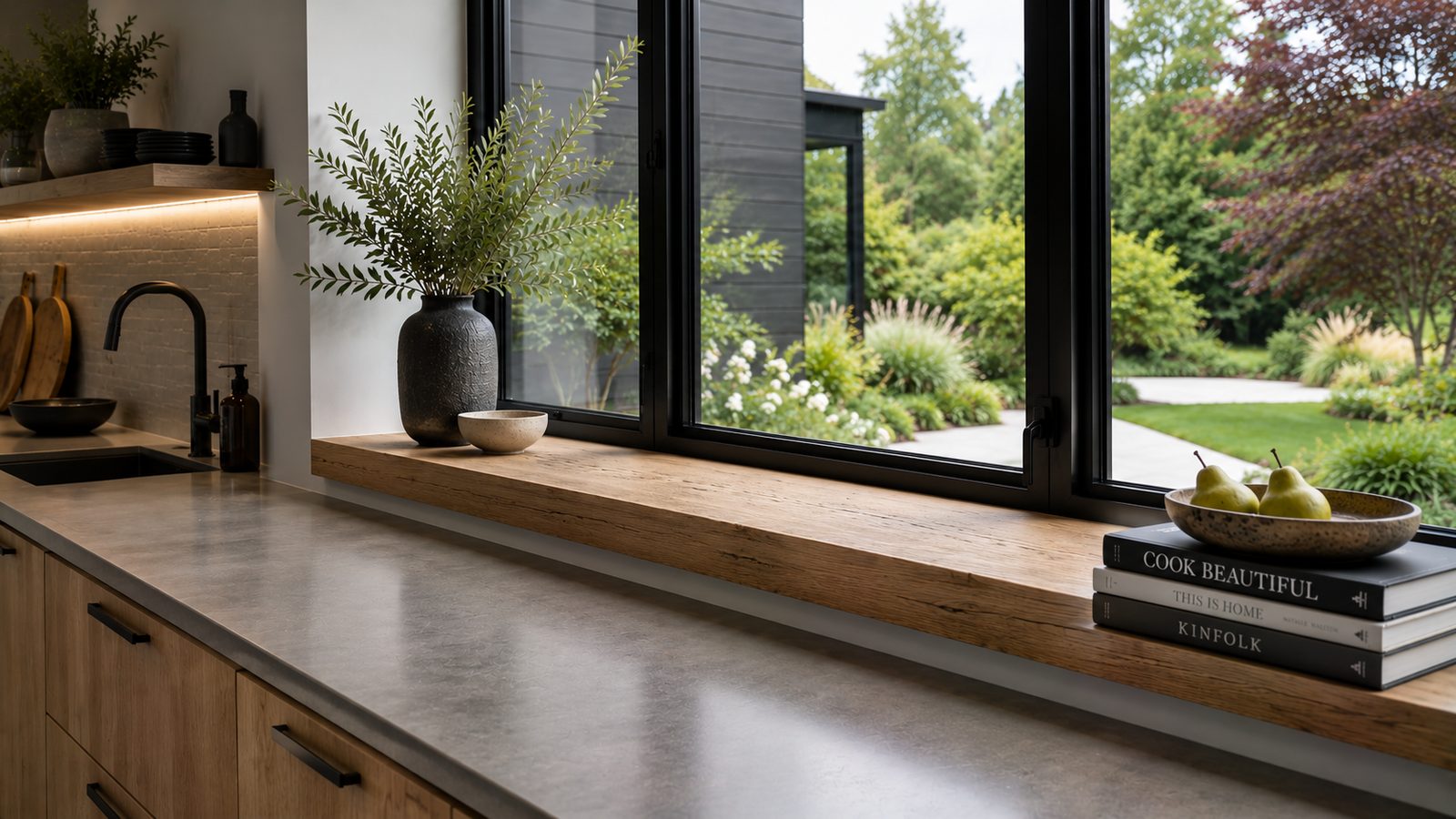
What we do about it
Stock is dried to interior moisture content before it is machined, not after. Wide pieces are built as a 3/4″ slab with a laminated front edge rather than cut from thick solid stock, which gives the visual mass of a heavy sill without the movement of one. Where the species and the width call for it we favour quarter and rift sawn boards, which move mostly at the smaller radial rate across their width and strongly resist cupping.
None of that stops wood being wood. Expect a small seasonal change in width on a wide sill. Expect it not to cup.
Built for the opening, not cut from a stock length
Most hardwood sill stock is sold as a lineal profile: a fixed width, a fixed edge, cut to length by whoever installs it. Ours starts from your measurements and is machined as one piece.
The slab and the edge
3/4″ solid hardwood, with the front edge built up underneath to a visual thickness of 1″, 1-1/2″, 2″ or 2-1/2″. The front reads as a solid board of that thickness; the piece behaves like a 3/4″ one.
The profile
Six machined profiles — eased, bevel, radius, cove, ogee, roman ogee — worked on the top arris, the bottom, or both, at a depth from 1/4″ to 1-1/4″. You pick which edges get machined, including the ends.
Returns and runs
Ears that run back along the wall past each side of the opening, at whatever length suits your casing. Or one continuous sill notched around the interior jambs of a two- or three-window run, with no joint over the pier.
Finish
Eighteen stain finishes, each one photographed on a real board rather than approximated from a colour swatch — what you see on the model is a photograph of the finish you are ordering.
A window sill takes more direct sun than almost any other interior surface, so finish choice matters. We are happy to talk through what will hold up in a south-facing room before you order.
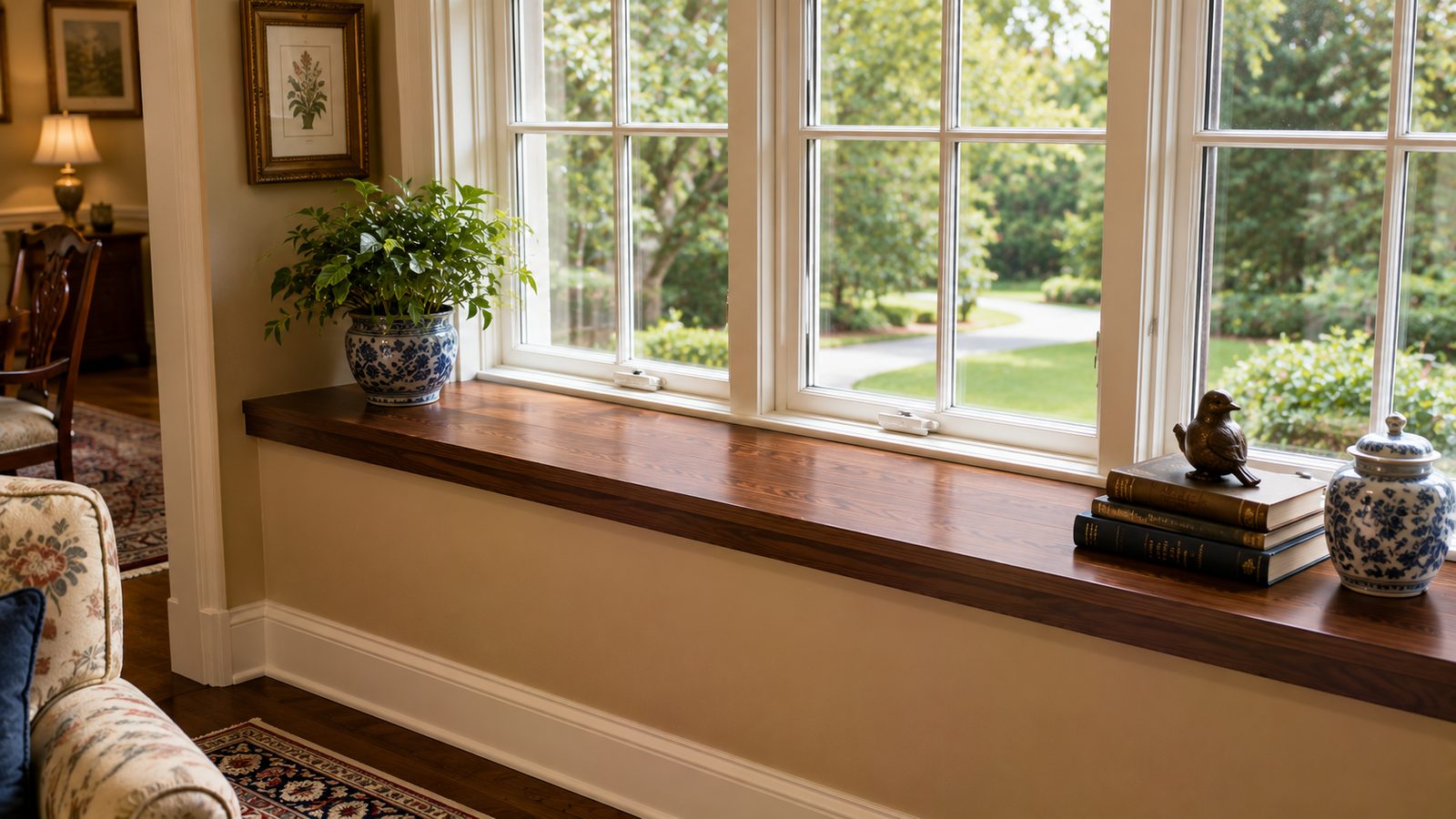
You see it, then you approve a drawing
The hardest part of ordering custom millwork is that you normally cannot see it until it arrives. A shop takes your dimensions over the phone, and weeks later a box turns up.
Configure it in 3D
Enter your opening and the model updates as you go — length, depth, thickness, profile, returns, finish. It is your piece on screen, in the wood you chose, not a stock photograph.
Get a dimensioned drawing
Every quote comes with a two-sheet drawing: a dimensioned plan with the edge treatment marked, and a section through the front edge showing the profile and build-up. Check it, or hand it to your carpenter.
Download the 3D model
An .OBJ of the finished piece, if you or your designer want to drop it into a room model before committing.
Three measurements

- Width, jamb to jamb. Inside the opening, at the sill line. If the two ends differ, give us both and tell us which is which — openings are rarely square and we would rather know.
- Depth, window to wall. From the face of the window frame out to the finished wall, plus however far you want it to project past the casing. Three-quarters of an inch to an inch past is the usual look.
- Returns. How far the ears run along the wall past each side, if you want them. Two to four inches is common.
Not sure? Send the numbers you have and a photograph of the opening. We would rather ask a question now than build to a wrong figure.
What we will not claim
It is wood, and wood moves
We machine to a tight tolerance, but a hardwood sill is not a machined metal part and it will not stay dimensionally frozen through a year of seasonal humidity swings. Anyone promising otherwise is selling you something. What we will say is that the construction, the drying and the sawing are all chosen to keep that movement small and to stop it cupping.
Colour on a screen is not colour in your room
The finishes on the model are photographs of real boards, which is better than a flat colour chip, but no screen is calibrated to your window’s light. If matching existing trim matters, ask us before you order rather than after.
We are a small shop
Every piece is made to order, so we are not going to be faster than a lumberyard with a stock profile on the shelf. What we are is exact: the piece is made to your numbers, and you see the drawing before it is cut.
Hardwood window sills, answered
What is the difference between a window sill, a stool and an apron?
Strictly, the sill is the sloped exterior member that sheds water, the stool is the flat interior board you set things on, and the apron is the trim directly beneath the stool. In practice almost everyone — including most of the trade — calls the interior board a sill, so that is the word we use. What we make is the interior stool.
Why choose solid hardwood over MDF or finger-jointed pine?
MDF swells when it takes on water from window condensation and does not shrink back, so the damage is permanent. Finger-jointed pine is paint-grade and soft, and dents easily. Solid hardwood can be stained, sanded and repaired, and a well-chosen board stays flat. It costs more, and it is the right choice when the sill is meant to be seen.
Does a solid wood window sill warp or cup?
All wood moves with humidity, and any maker who tells you otherwise is overselling. We reduce it rather than claim to eliminate it: stock is dried to interior moisture content, wide pieces use a 3/4″ slab with a built-up front edge rather than thick solid stock, and we favour quarter and rift sawn boards where the species and the width call for it. Expect a small seasonal change in width. Expect it not to cup.
Which hardwood is the most stable for a window sill?
Of the species we offer, cherry and walnut move the least. Using the USDA Forest Products Laboratory figures for total tangential shrinkage, cherry is 7.1% and walnut about 7.8%, against 9.9% for hard maple and 10.5% for white oak. White oak moves roughly one and a half times as much as cherry across the grain. All four are used for sills every day; the difference matters most on a wide opening.
Can one sill span two or three windows?
Yes. We make continuous runs across multiple openings, notched around the interior jambs between them, so there is no joint over the pier. Tell us the opening widths and the jamb widths between and the piece is cut as one.
Do you ship nationwide?
Yes, anywhere in the United States. The sill is made to the measurements you give us and shipped finished.
What do I get before you build it?
You configure the piece in the browser and see it rendered in 3D as you go. Every quote comes with a two-sheet dimensioned drawing showing the plan, the edge section and the finish, plus a downloadable 3D model. Nothing is cut until you have seen the drawing.
Shrinkage figures: USDA Forest Products Laboratory, Wood Handbook: Wood as an Engineering Material (FPL-GTR-282), Table 4-3 — total shrinkage green to ovendry. Published values for comparing species; actual in-service movement depends on your indoor humidity range.
Configure your sill
Enter your opening, pick the species and the edge, and see the piece before you commit to it.