Custom Window Sill Gallery
Twelve made-to-measure window sills shown as studio pieces, so the shape itself is the subject — the return horns, the notches that carry a single length across a multi-window opening, the machined front edge and the flush contrasting inlay. Six hardwood, three solid surface, three inlaid. Browse by material, then configure your own or see the full materials and colors.
Every image below is a rendering, shown to illustrate the shapes, materials and proportions available through the configurator. More pieces are being added.
Hardwood Window Sills
Solid walnut, white oak, maple and cherry, clear-finished or taken to a stained colour that still shows the grain. The front is built up from laminated stock so the piece reads as one thick slab rather than a trim board.
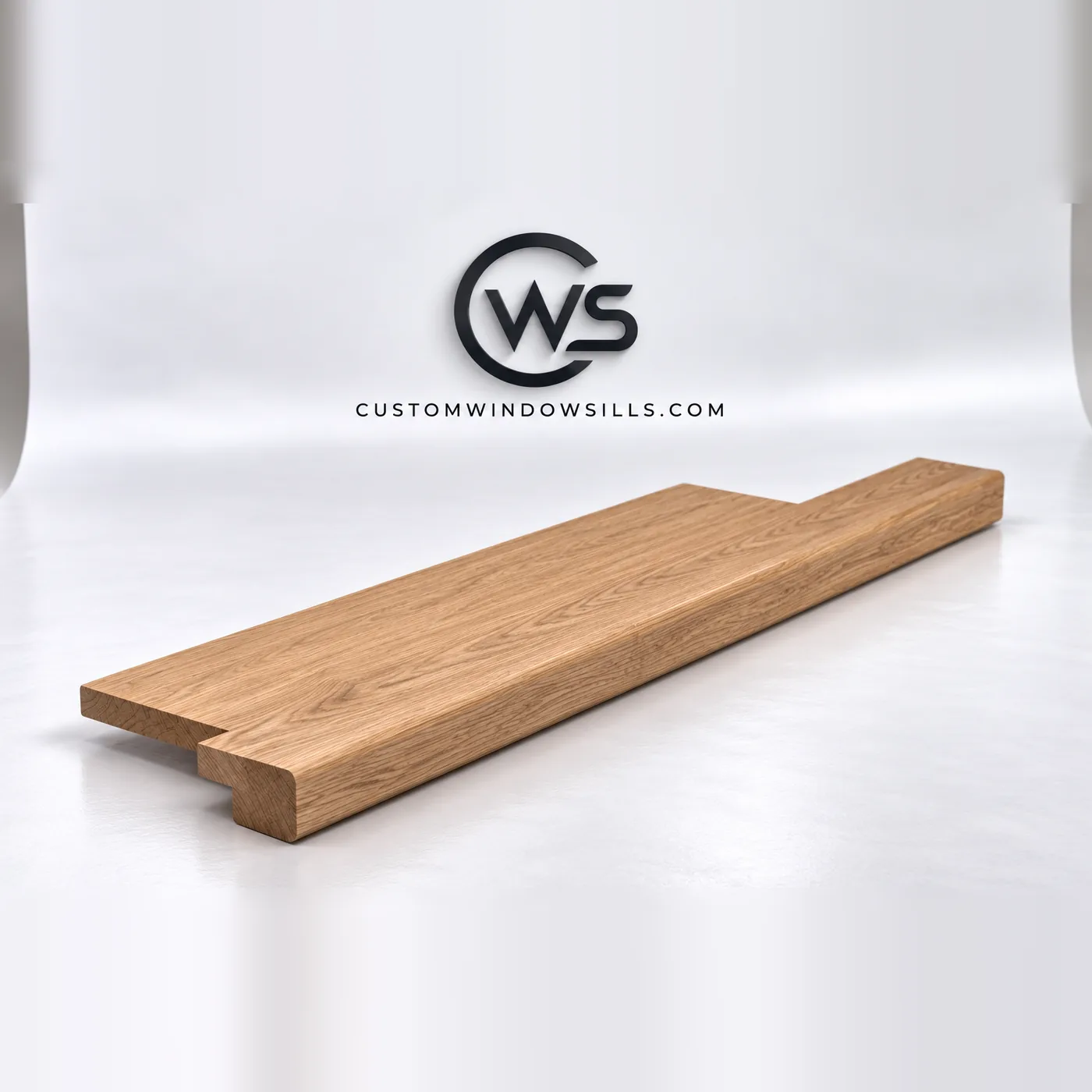
White Oak, Bullnose Front Edge
Natural white oak left unstained, with the front arris softened to a bullnose and a single return horn notched at one end. The horn is what lets a sill run past the jamb and die into the wall rather than stopping short of it.

Walnut, Eased Edge
A warm walnut tone over open grain, with a fine reveal scribed below the front edge and one return horn. The eased arris takes the sharpness off the front without reading as a moulding.

Dark Walnut, Stepped Front Edge
Deep walnut over a coarse open grain, with a stepped reveal machined along the front edge so the face reads as two stacked bands rather than one blank slab. A single return horn at the far end.

Dark Oak, Multi-Window Run
One length cut for a multi-window opening. Two notches drop past the jambs between the openings, so a single piece carries the whole run instead of three pieces butted together — no joints to open up later.

Oak, Profiled Front Edge
A long honey-toned oak sill with a profile machined along the front edge. At this length the front edge is the only detail visible from across the room, which is where a profile earns its keep.

Teal-Stained Hardwood, Multi-Window Run
A deep teal dye carried over open hardwood grain, so the figure still reads through the colour rather than being buried under it. Cut as one length for a multi-window run: two notches drop past the piers between openings, with a return horn at each end.
Solid Surface Window Sills
Non-porous solid surface in 77 colors, seamless and repairable. Because it is homogeneous through the thickness, the build-up edge can be machined to any profile with no visible seam.

Speckled Grey Solid Surface
Grey aggregate solid surface, squared at the front and returned at one end. Because the material is homogeneous through its thickness, the build-up edge shows no seam where it meets the deck.

Cream Travertine Solid Surface
A cream travertine pattern with soft veining, squared at the front and returned at one end. Non-porous, so it takes condensation and cleaning without sealing, and a scuff sands out rather than needing refinishing.

Grey Solid Surface, Multi-Window Run
A dense grey solid surface with a fine speckle, machined with a profiled front edge and cut as a single multi-window length. Two notches clear the piers between openings, and because the material is homogeneous the profile runs through with no seam or edge banding.
Inlay Window Sills
A contrasting hardwood inlay let in flush along the front edge, running the length of the piece and breaking for a group of three squares over each window jamb. See the full range of inlay window sills.

Natural Cherry with a Walnut Inlay
Natural cherry, unstained, with a walnut inlay let in flush along the front edge. Cherry starts light and darkens with light over the first year, so the contrast against the walnut settles rather than staying fixed. A return horn at one end and a notch at the other.

Honey Oak with a Walnut Inlay
A walnut inlay let in flush along the front edge of a honey-toned oak sill. The long run breaks for a group of three squares set over the jamb, then picks up again — the Arts & Crafts square motif, cut into the edge rather than applied to it.

White Oak with a Walnut Inlay
The same inlay in paler white oak, where the contrast between the ground and the walnut does more of the work. The three squares mark the jamb below, so on a wider opening the groups land over the piers rather than at even spacings.
Sills in finished rooms
Eight of the same sills shown installed — kitchens, baths, bedrooms, living rooms and studies, in hardwood and solid surface.
White Oak Sill in a Modern Kitchen · Walnut Sill in a Bedroom · Walnut Window Stool, Traditional Room · Walnut Sill in a Reading Nook · Wide Walnut Sill, Living Room · White Solid Surface Sill · Cream Solid Surface Sill in a Bath · Limestone-White Sill at the Tub
Build yours to the same spec
Enter your opening dimensions and the configurator draws the sill live and produces a dimensioned spec sheet. Cut with machine accuracy.
Read the measuring guide, compare wood vs. solid surface, or browse edge profiles.